Notion for Interior Designers: When You Need an Alternative
Notion is great for studio docs, tasks and custom databases. Here is how to tell when your product images, spec sheets and client approvals have quietly become a system you maintain by hand, and what to move where.

Table of contents
Share
Notion is flexible. You can build a project board, a task list, a client database and a moodboard page, then shape each of those to your liking. If you enjoy building systems and your projects are on the smaller side, then it's a fair place to start. There's definitely a lot to like and real-time editing with page comments mean a small team can keep notes and decisions in one place without much friction.
Plenty of designers run their studio in Notion and are happy with it. Client contacts, project briefs, timelines, a list of suppliers, the stuff that benefits from a nice home in a database. Notion handles all of that quite well. The question is whether it is the right home for the specification side of the work.
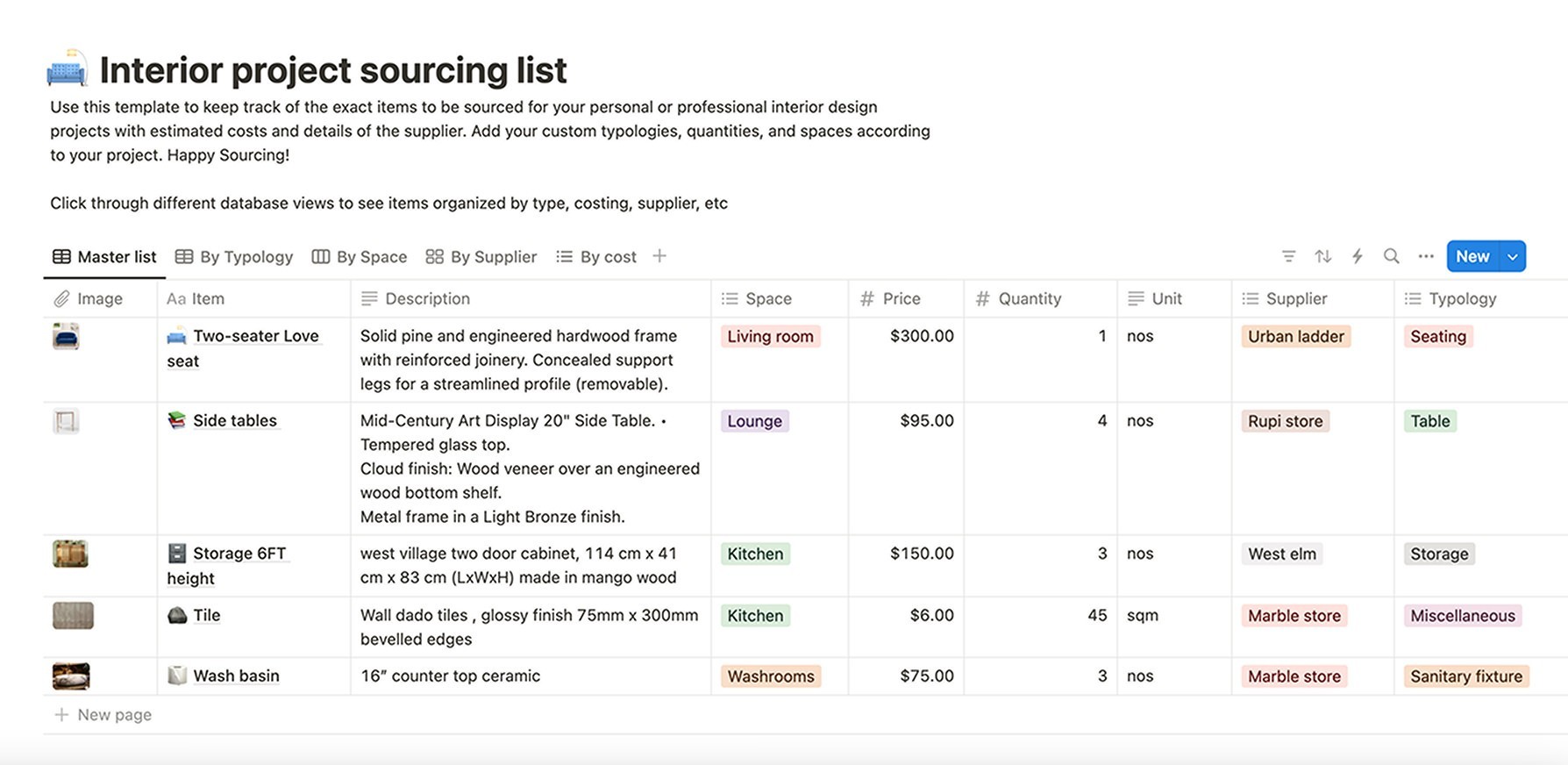
A general workspace holding product imagery and details for several rooms at once, where a lot of the layout and upkeep is on you.
Where the upkeep starts to creep in
The specification side is where a general workspace starts asking for maintenance. A designer specifying a room is not filling in a tidy database. You are pulling a pendant from one supplier site, a fabric from another and a sofa from a third. Each one arrives with an image, a price, a lead time, a product code and a link that all have to land somewhere useful.
In Notion you decide how that lands. You set up a database, choose the fields and choose how each one gets filled: which details you paste in, which images you upload, which links you keep. Do it for one project and it is fine. Do it across several projects for hundreds and hundreds of products and you might start to question life. Product-specific details are all manually copy-pasted and cleaned up by hand, alongside the odd spreadsheet and a folder of downloads.
Usually it's two things that break first. Product images never quite sit the way you want, so a page of specifications is harder to read at a glance than it should be, for you and for the client. And when you share a Notion page with a client for sign-off, the layout that makes sense to you is not always easy for them to follow, so approvals drift back into email and messages, away from the item they are actually about. What you get is more of your week spent formatting and chasing than designing, inside a tool that was never meant to be a specification workflow.
Paola Castillo, founder of Own Space Interiors, ran exactly this kind of setup before she changed tools. As she put it, "I was using Notion and before Notion I was using Excel. It was like a massive thing." The stitching between tools was the part that wore her down: "I was copy-pasting images into one file, saving links in another. It just wasn't sustainable." You can read Paola Castillo's Own Space workflow in full.
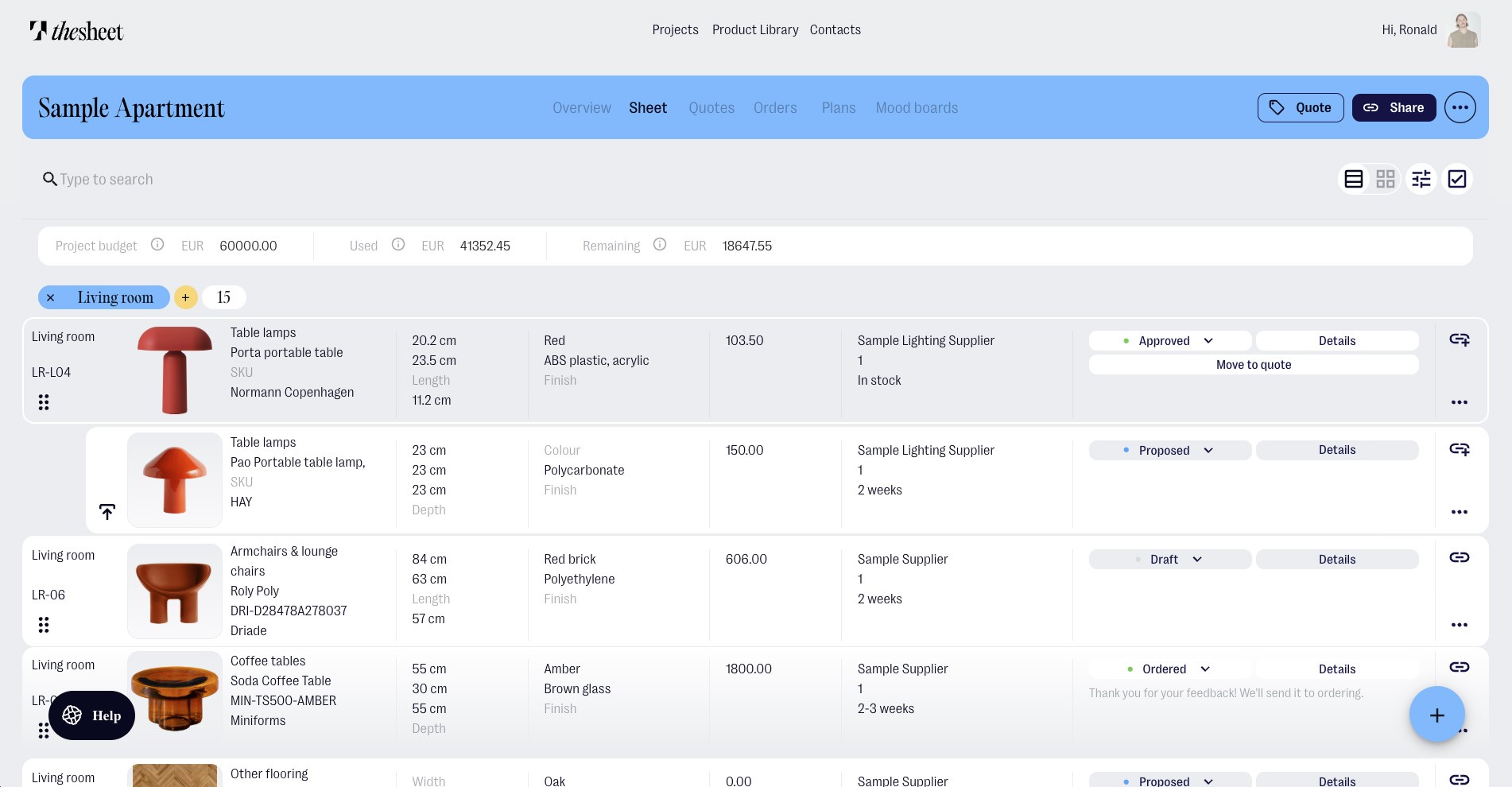
The same product information in a purpose-built spec sheet, organised by room, category and status.
Deciding whether to move the specification work
You do not need to leave Notion to answer this. Look at where your hours actually go on a project. Be honest about which of them are design and which are admin. If most of your Notion time is spent formatting product information and rebuilding the same setup for each new project, then that might be a good hint.
A few practical questions that tend to settle it:
Are you saving product images and links by hand, in more than one place, for the same item?
Do you rebuild the same database or template every time a project starts?
Do client approvals happen somewhere other than on the product being approved, so you lose track of what was decided?
Do you reuse the same products across projects but re-enter them each time?
What you are looking for is a pattern rather than the odd busy week. If those questions keep describing how your projects actually run, the specification work has outgrown a general workspace and the product, spec and approval side is worth moving to something built for it while Notion keeps the rest.
How does thesheet compare to Notion
thesheet is specification software made for interior designers, so the comparison below is not like for like. Notion is a general workspace you shape yourself. thesheet is a narrower tool that already knows what a spec sheet, a product and a client approval are. Here is how they line up on the work designers actually do.
The work | Notion | thesheet |
|---|---|---|
Capturing products from supplier sites | Configure a database and decide how each field gets filled, with manual cleanup for product-specific details | Clip a product with the AI Product Clipper or paste a supplier URL, then thesheet fetches the details in a few seconds |
Building spec sheets | Design your own template, then keep formatting it | Spec sheets are the default, organised by room, category and status |
Reusing selections across projects | Build a reusable database, connect it to your projects yourself and maintain the structure | Save an item once to the Product Library and reuse it |
Client approvals | Share a page and collect feedback in comments or email | Clients approve, reject and comment on the item itself through a client link |
General docs, tasks and custom databases | Strong and flexible | Not what it is for |
Starting commitment | You can start in a workspace you already have, but the specialist setup is yours to build and maintain | You can test it on one free project on Solo. See pricing for the details |
Where Notion is still the better fit
If your studio lives in one flexible workspace and you like it that way, keep it. Notion is a good home for briefs, timelines, task lists, internal notes (although thesheet also has internal notes that you can leave on products) and any custom database you have already tuned. If you run content, admin and project tracking side by side and only occasionally build a light product list, the effort of a second tool may not be worth it. And if you enjoy designing your own systems and don't really mind the upkeep, then you might not find it as difficult as many do.
Plenty of studios keep briefs, tasks and notes in Notion and move only the specification work elsewhere.
Where thesheet is the better fit
thesheet is worth a look when the product and specification side is just taking too long and your client-facing spec sheet might not be on the level you'd like. Because it is built for interior design, the setup you were doing by hand in Notion is already there.
Capturing and reusing products
You source a product while you work and clip it straight into the project with the Product Clipper. If a page is awkward to clip, you paste the supplier link straight to the project instead and let thesheet pull the image, price and details with AI. Save a product once to the Product Library and it is there for the next project, so the pieces you specify again and again stop being a retyping job. If you are coming from a spreadsheet as well as Notion, you can import an existing product list in from Excel rather than retyping it.
Getting client decisions made
Instead of sharing a page and chasing replies, you send one client link. The client reviews, approves or comments on each product in context, so the decision stays attached to the item being decided and you are not reassembling it from a message thread later. That keeps approvals and comments in one predictable place. It is close to what Paola described after she switched: "I spend less time on management now so I can focus more on being creative."
If you are still weighing up whether a dedicated tool is worth it at all, it is worth reading how designers choose specification software before you commit.
The short version
Keep Notion for flexible studio docs, tasks and custom databases. Move product capture, image-heavy spec sheets, reusable selections and client approvals to thesheet once they have turned into manual upkeep. For most designers this is not an either-or.
The easiest way to tell is to try it on real work. Start free with thesheet and run one project through it, from clipping the first product to sending the client link.