Best Studio Designer Alternative for Smaller Interior Design Studios
Studio Designer runs the whole business, general ledger accounting included. Here is how to tell whether your studio needs all of that or whether the job you actually need fixed is product capture, spec sheets and client decisions.

Table of contents
Share
If you are shopping for a Studio Designer alternative, the answer usually comes down to scope. Studio Designer is the better choice when you're looking for a platform that includes accounting, procurement, time billing, payments, proposals, purchase orders, invoices and detailed reporting. thesheet makes more sense when most of your time goes into getting products into structured spec sheets, reusing them across projects and getting clear client decisions, without adopting a full finance and operations system to do it.
This analysis is most useful for solo designers, small studios and the leaner medium ones: practices where the bottleneck is specification and sign-off rather than bookkeeping.
The week that sends designers looking for an alternative
It tends to start mid-project. Three rooms to specify, forty-odd products, a client meeting on Thursday. The pendant is a browser tab. The fabric is a PDF from a rep. The sofa is a screenshot in your downloads. You are retyping product codes into a spreadsheet at eleven at night because the spec goes out tomorrow.
Then the client replies in WhatsApp asking to see a different dining chair. Someone changes a price in the spec sheet. Three weeks later nobody can say which sofa was signed off.
That is the week that sends a studio looking for proper software. Studio Designer is one of the first names you find and it presents itself as a single system for running a design business.
Name the job before you compare feature lists
Most studios arriving at this point are trying to fix one of three things:
getting products off supplier sites into a project without retyping them;
producing a spec sheet a client can read without pinching across forty columns of a spreadsheet on a phone;
holding a decision in a place you can point at three months later.
None of that is accounting. General ledger, payroll, time billing and inventory valuation are real problems for plenty of firms, but they are rarely what has a studio owner comparing software at eleven at night.
What Studio Designer is built to run and where the breadth might start costing a smaller studio
Studio Designer describes itself as a fully integrated business solution for interior designers, which matches what its pricing page lists: project and design management, a catalog with AI rendering, procurement, a client portal with time billing, payments through StudioPay, full general ledger accounting, proposals, purchase orders, invoices and reporting. That is an operating system for a design firm, and firms that need one are right to buy it.
That much scope is sized for a firm with a bookkeeper, someone handling procurement and enough project volume to justify the machinery. Buy a system built to run a whole business and you take on all of it, including the parts of your studio you were not trying to change.
What a right-sized specification workflow needs
This is useful whichever product you pick. If specification and client decisions are the work you want to improve, judge any tool against these:
capture: can a product go from supplier page into the project without retyping image, price and product code?
reuse: when you specify the same reading lamp for the fourth time, is it already there?
the client view: does what you send look like your studio's work rather than a spreadsheet export, with trade prices hidden unless you want them shown?
the decision trail: can the client approve, reject or comment on the item itself, so the answer stays attached to it?
how much setup, training and contract you take on before you know whether it fits.
Run your current setup through those. Two of them are usually where the evenings go.
Studio Designer and thesheet, side by side
These are different classes of product. Studio Designer is a business platform that includes specification work. thesheet is specification software that stops short of your accounts. Here is how the decisions line up on current first-party pages.
The decision | Studio Designer | thesheet |
|---|---|---|
Core job | The whole design business: projects, procurement, billing and books in one platform | Product capture, structured specifications, client sharing and approvals |
Getting products in | Catalog with AI rendering, per its pricing page | AI Product Clipper or a pasted supplier URL pulls image, price and details |
Spec sheets | Part of a wider project, proposal and purchase-order flow | The default unit of work, organised by room, category and status |
Reuse across projects | Catalog and project records | Save once to the Product Library and pull into the next project |
Client review | Client portal with time billing and proposals | Client link with item-level approvals and comments, customisable sharing, PDF, studio branding |
Accounting and payments | Full general ledger accounting, StudioPay and detailed reporting | Not included. It does not replace your accounting stack |
Money inside the project | Proposals, purchase orders, invoices, time billing and inventory | Quote requests, purchase orders, service items and margin tables |
Team model | Priced per user | Studio includes two seats, additional seats €19/month |
Published monthly price | $79 Essentials, $89 Enterprise or $119 Premier per user, month to month | Solo free with one active project. Studio €35/month including two seats |
Starting commitment | Setup required for all accounts. Annual plans cannot downgrade until the term ends | One free active project. No contract or cancellation fee |
When Studio Designer is the right call
Choose Studio Designer when your books belong in the same place as your projects. If you raise client invoices, run purchase orders through procurement, bill time, take payments, track inventory and produce financial reports, one system beats stitching four together. The setup work is the point of it: what you are buying is operational control.
If that is your studio, a lighter specification tool leaves the finance somewhere else, and you will feel it every month end.
When thesheet is the right call
Choose thesheet when the specification side is what slows you down and your accounting already works. It is built for the loop between finding a product and getting a client to say yes to it.
Getting products in without retyping
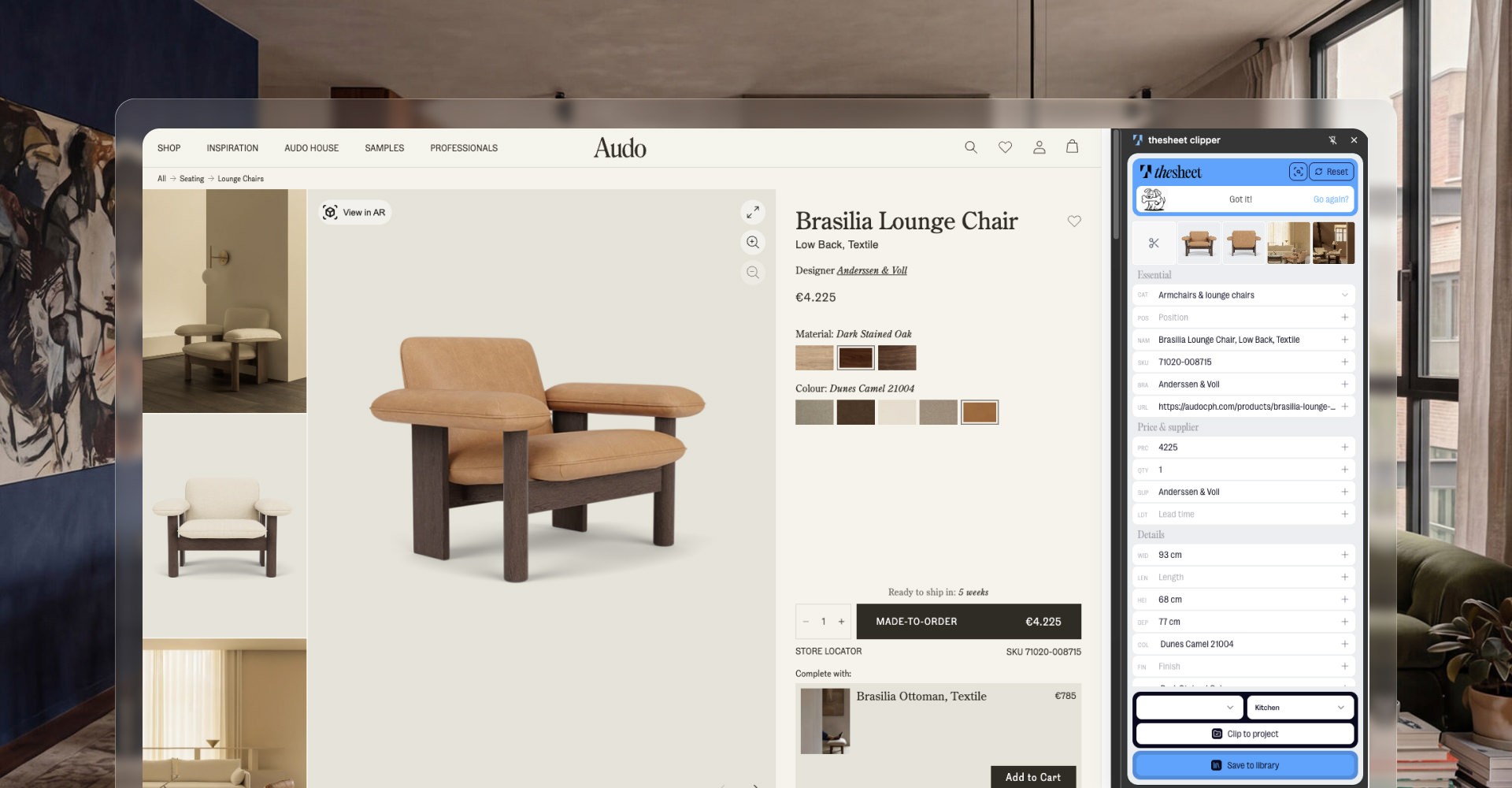
You are on a supplier site. You clip the product straight into the project with the AI Product Clipper. If the page is awkward you paste the URL instead and thesheet pulls the image, price and details across. Save it once to the Product Library and the next project starts with it already there. If your products live in a spreadsheet today, the Excel to spec sheet comparison covers bringing that list across.
A spec sheet the client can decide from
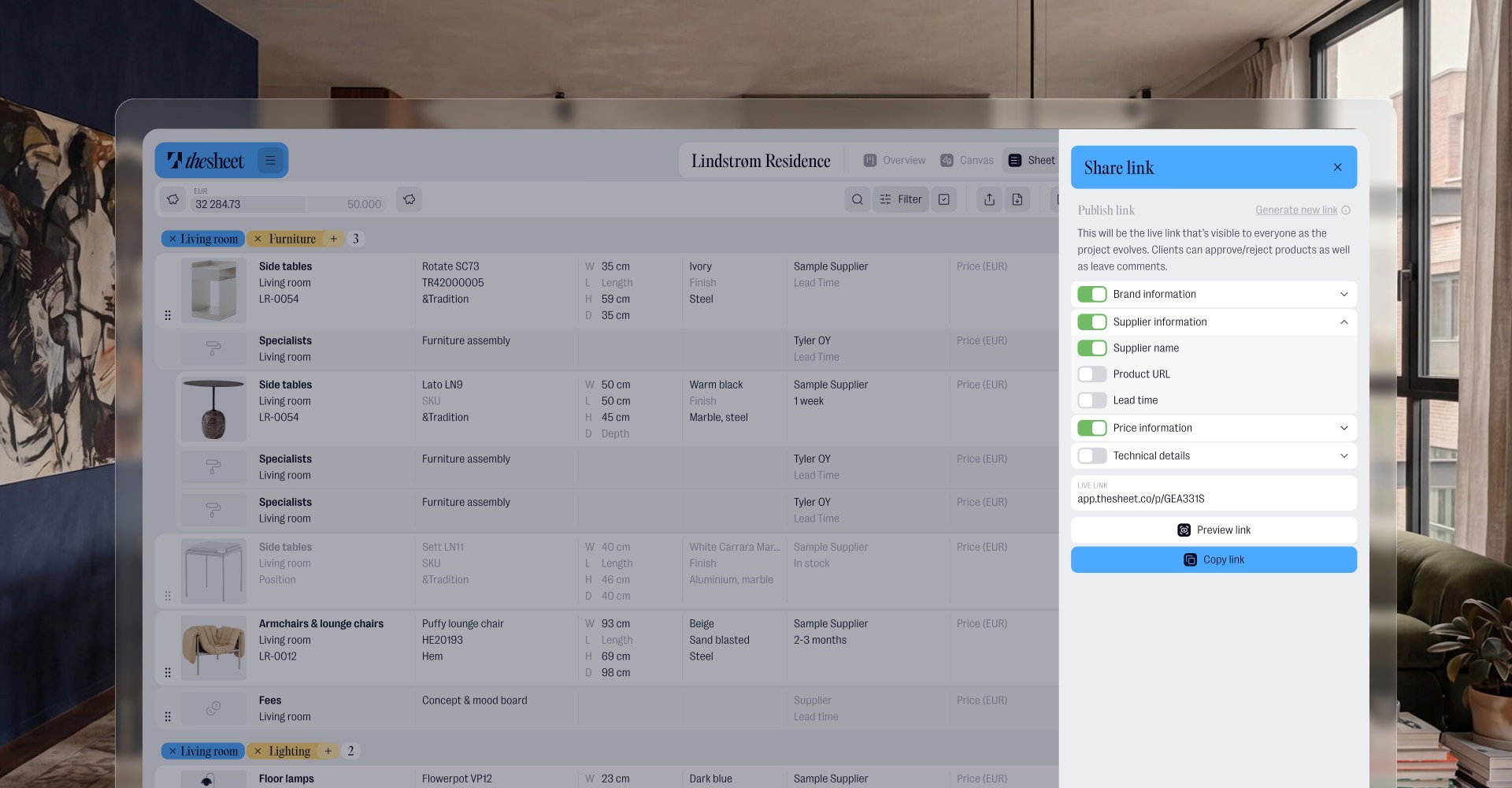
Specifications are the default in thesheet, organised by room, category and status, so you are not reformatting a document every time the scope changes. You send one client link rather than a file. The client approves, rejects or comments on each item in place, which is the difference between a decision you can point at and a thread you have to reconstruct. Sharing is yours to control: studio branding on, supplier and cost columns off, PDF export when someone insists on paper. The guide to structuring spec sheets shows that structure in practice.
The money parts thesheet does cover
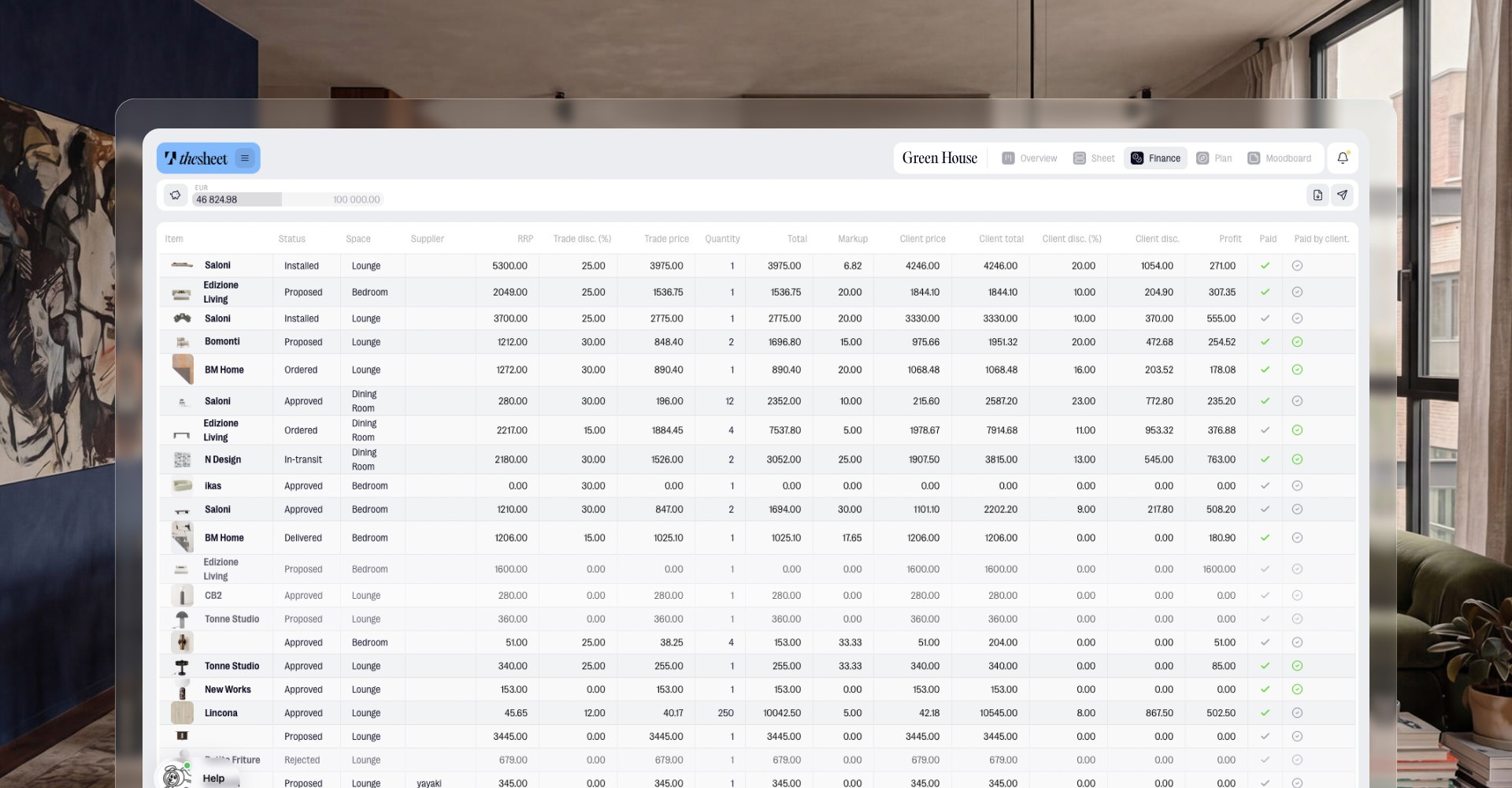
thesheet is not accounting software, but it does allow to track project finances and margins alongside being able to add services next to products. Plus you get project overview to keep an eye on your order statuses and Plan View for the client to see selections on a floor plan. No general ledger, payroll, time billing or payment processing. For many studios that works well because their accounting system is already in place.
thesheet is also no-risk to try. Solo is free with one active project, unlimited products and library, five AI clips a day, client sharing with approvals and basic PDF export. Studio is €35 a month including two seats, extra seats €19, adding unlimited projects, unlimited clipping, customisable sharing and PDF, Plan view, team permissions, studio branding and margin tables.
The short version
Studio Designer if the accounting, procurement, time billing, payments, inventory, invoicing and reporting need to sit in the same platform as your projects, and you have the appetite for the setup that makes that work. thesheet if your studio is smaller or operationally lean and the pressing job is capturing products, building structured specifications and getting client decisions, without buying a finance and operations platform to get there.
If you are also looking at the specification-platform end of the market, the Programa alternative comparison covers that and why simple specification software wins for small studios gives you the skinny on why simple is good.
The quickest way to settle it is one real project. Start free with thesheet, clip ten products from your current job and send the client link. One project run end to end will tell you more than any comparison table.